What are Ordeals in 33 Immortals?
In 33 Immortals, Ordeals are best understood as optional challenge layers that raise the pressure of a run in exchange for better long-term goals and reward planning. They are not the same as a normal room objective, a simple boss phase, or a weapon upgrade. The useful mental model is: choose an Ordeal, accept a tougher rule set through Agony, then play the run with more discipline because small mistakes become more expensive.
Similarweb data supports a separate page for this topic. The exact phrase match keyword '33 immortals ordeals' shows 1,510 recent window volume with difficulty 4, and 'ordeals 33 immortals' adds 670 volume with difficulty 12. Related keywords include '33 immortals major feats' at 1,810 volume and difficulty 1. Those searches do not fit cleanly into the existing weapons, codes, multiplayer, platforms, or Empathy pages, so this page keeps the Ordeals cluster separate.
The practical answer for players is simple: do not start with the highest pressure setting just because it promises better rewards. First build a reliable weapon loop, learn revive timing, understand how your group handles elites and bosses, then raise Ordeal pressure when your deaths are caused by execution limits you can actually fix. Ordeals reward controlled teams more than impatient teams.
Treat Ordeals as challenge contracts. Pick one when your group can survive normal raids consistently, then use Agony and Major Feats to decide whether the extra risk is worth the run.
Ordeals, Agony, and Major Feats compared
Search results often mix these terms together. Use the table to keep each decision separate before you change your build or raid plan.
| Term | What it means | What players should do |
|---|---|---|
| Ordeals | Challenge layers or run conditions that make a raid more demanding. | Choose them after your group can already finish standard pressure without constant deaths. |
| Agony | A difficulty pressure concept tied to harsher Ordeal attempts. | Raise it gradually and watch whether deaths come from damage greed, bad spacing, or missed revives. |
| Major Feats | Longer-term achievement-style goals connected to harder play and progression proof. | Track one or two at a time instead of warping the whole team around too many goals. |
| Rewards | The reason players accept extra risk, usually tied to progression, unlocks, or prestige. | Do not chase rewards before your weapon, relic, and revive habits are stable. |
| Team readiness | The real gate: whether the raid can react calmly when enemies, bosses, and objectives overlap. | Use communication, role clarity, and conservative builds before pushing harder settings. |
How an Ordeal attempt usually escalates
This editorial flow is not a fake screenshot. It is a crawlable planning diagram for deciding whether your next Ordeal attempt should be harder or safer.
Baseline clear
Finish normal pressure while keeping deaths, panic movement, and missed revives under control.
Choose Ordeal
Pick the challenge that matches your team weakness instead of stacking every hard option at once.
Handle Agony
Treat harsher pressure as a test of spacing, target priority, and revive timing.
Review reward
After the run, decide whether the payoff justified the risk or whether a lower setting was more efficient.
Ordeal planning flow. Keep the decision visible: prove the baseline, choose a challenge, survive the pressure, then review rewards and mistakes.
How to prepare before pushing Ordeals
The safest Ordeal preparation starts on easier runs. Pick a main weapon, decide whether your role is control, ranged pressure, revive support, or boss burst, then upgrade around that job. A player who changes weapons every run rarely learns whether the Ordeal failed because of the challenge or because their basic loop was unstable.
Team behavior matters more in Ordeals than in casual farming. Stay close enough to revive, but not so close that one boss pattern hits the whole group. Avoid chasing isolated enemies if the objective or downed players are behind you. When the screen gets crowded, a conservative revive and a clean regroup are often worth more than one extra damage window.
Use the Ordeal result as feedback. If your group dies early, lower the pressure and fix fundamentals. If you reach bosses but run out of damage, test weapon upgrades and relic synergy. If you clear but waste too much time, assign clearer roles. The goal is not to prove toughness; it is to turn a harder rule set into repeatable progress.
Major Feats: how to chase goals without hurting the run
Major Feats are a useful related cluster, but they should not steal the entire Ordeals page. Think of them as goals that sit beside Ordeal planning.
Pick one priority
A team that tries to satisfy every feat condition at once usually loses the run. Choose the feat that fits the current build and route.
Do not hide the goal
If you are changing behavior for a feat, tell the party. Silent detours and greedy positioning create avoidable deaths.
Separate farming from clears
Some sessions are for learning and unlocks; others are for stable clears. Mixing both goals can make every decision worse.
Recheck patch notes
Achievement, reward, and challenge wording can change. Use official notes and live in-game text before treating old community advice as final.
Convert Major Feats into permanent progress
Major Feats are not just side challenges: official 1.0 notes connect them to Bright Stars and new Constellation upgrades. Before a run, choose a feat that your weapon and party role can complete without abandoning revives or objectives, then spend the reward on the permanent path that fixes a repeated weakness.
Common Ordeal mistakes to avoid
- Raising Agony before the group can clear normal pressure consistently.
- Choosing a risky damage build while also expecting to handle revives and objectives alone.
- Treating Major Feats as more important than the raid's survival.
- Reading one community post and assuming reward values or difficulty rules never change.
- Ignoring platform, crossplay, or party coordination limits before planning a serious attempt.
Official video context for harder co-op planning
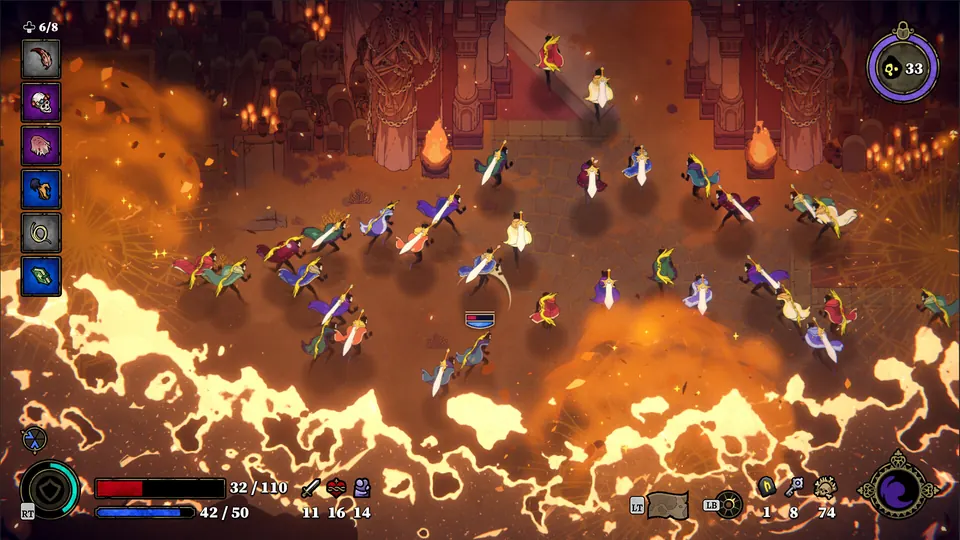
Use official 33 Immortals video context to understand the game's large-scale co-op pressure before pushing Ordeals. The embed supports the section; it is not used as a substitute for the text guide.
Sources checked
- Official Steam listing - Used for first-party positioning, release status, official screenshots, and store wording.
- Thunder Lotus 33 Immortals FAQ - Used for the official 33-player co-op description, platform context, and support wording.
- Thunder Lotus update notes - Used for official update context around Agony, Major Feats, and the Ordeals feature.